
What Is West Coast Swing?
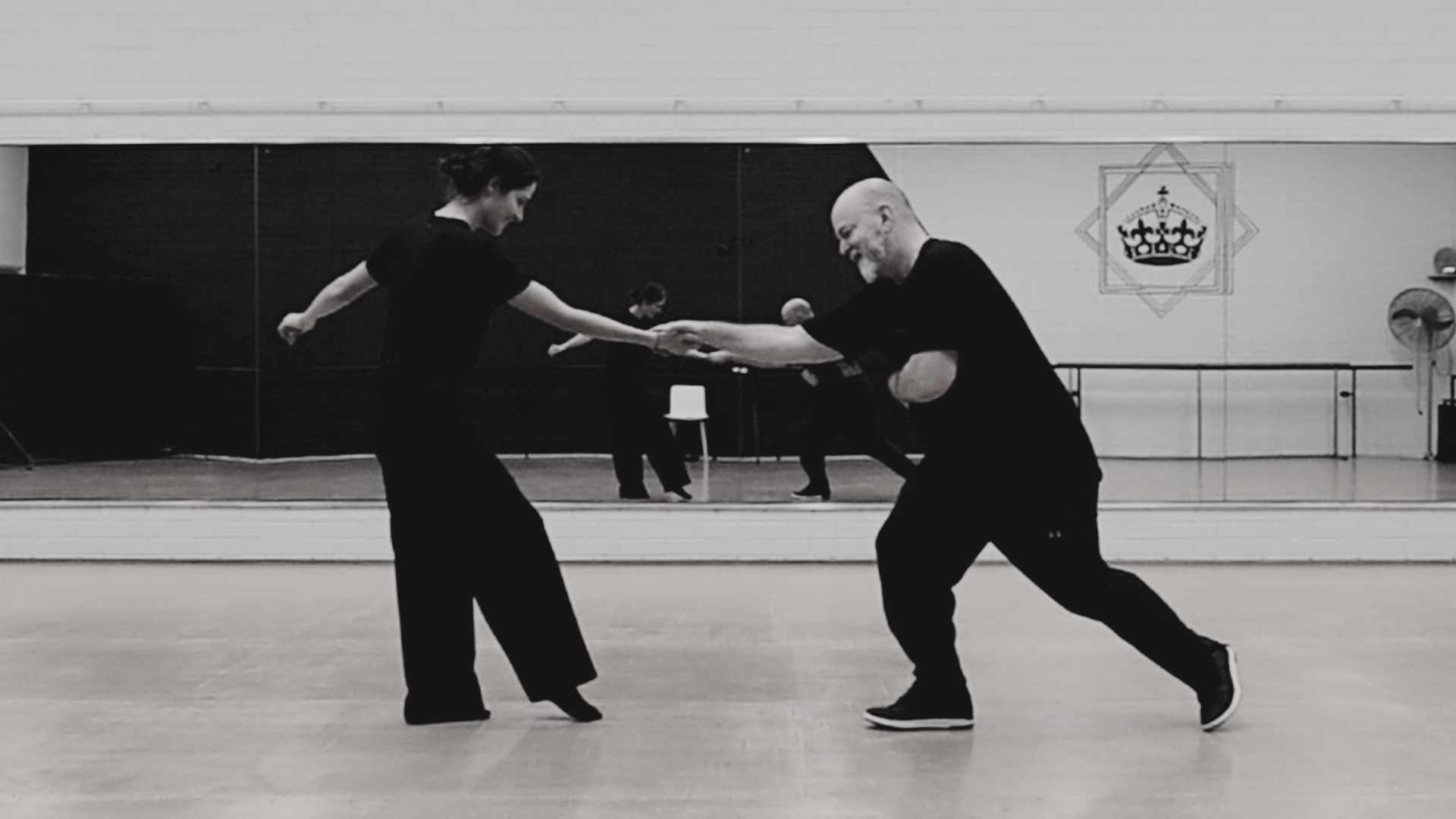
West Coast Swing is a modern partner dance known for its smooth movement, musicality, connection and freedom to improvise.
Unlike many partner dances that are closely associated with a particular style of music, West Coast Swing can be danced to an enormous range of contemporary music. You’ll see dancers moving to pop, R&B, blues, soul, acoustic tracks, hip-hop influenced music and plenty more.
But the music is only part of what makes West Coast Swing different.
At its heart, West Coast Swing is a conversation between two dancers.
There is a leader and a follower, but as dancers develop, both partners have opportunities to influence the dance. They respond to each other’s movement, interpret the music, improvise and sometimes create moments neither person could have planned before the dance began. Those improvised movements are very often original combinations with varied timing, footwork, counterbalance and connection points and more, which is why they may never be repeated… EVER! That’s what makes West Coast Swing a truly unique dance.
You can learn a handful of what we commonly refer to as ‘basic patterns’ relatively quickly.
Understanding what you can eventually do with them can become a lifelong journey.
What Makes West Coast Swing Different?
If you’ve watched experienced West Coast Swing dancers, you may have wondered exactly what you’re looking at.
Sometimes the dancing is smooth and flowing. Sometimes it’s playful. Sometimes it’s sharp and musical. At other times the dancers seem to stop, stretch, redirect or completely abandon the pattern you thought they were dancing.
The video below shows Champion Level dancers, Semion Ovsiannikov & Maria Elizarova dancing an improv dance as part of the Pro Show at Budafest in 2020.
That’s because West Coast Swing isn’t simply about learning a sequence of steps.
The basic patterns give dancers a structure, but connection and technique allow them to start playing within that structure.
Several characteristics help make West Coast Swing distinctive.
It’s highly improvisational
West Coast Swing isn’t normally danced as a memorised routine – instead, it’s danced socially an in most competitions as an improvised dance. Side note: WCS can be choreographed into a routine, specifically for two types of competitions/exhibitions called ‘Classic’ and ‘Showcase’.
In social dancing, neither dancer knows exactly what is going to happen before the song starts. In fact, many times dancers are dancing to songs they are only just hearing for the first time!
The leader generally initiates the pattern or movement, but the follower isn’t simply being moved through a predetermined sequence. As both dancers become more experienced, there is increasingly more opportunity for individual expression, variation and interaction.
A follower might interpret something in the music and influence the timing or movement. The leader can respond to that idea, which might create another opportunity for the follower.
It becomes a conversation.
Both partners can be creative
This is one of the things that becomes particularly exciting as your West Coast Swing develops.
Beginners understandably spend much of their time thinking about where their feet go and trying to remember patterns.
Eventually, those foundations become more automatic.
You start to understand why the dance works. That’s when the possibilities really start opening up.
Instead of: “What’s the next pattern?” you start thinking more about movement, connection, timing and music.
The leader’s creativity can inspire the follower. The follower’s creativity can inspire the leader.
The dance becomes something you’re creating together.
It’s danced to a huge variety of music
For many dancers, this is one of West Coast Swing’s biggest attractions.
Walk into a West Coast Swing social or event and you might hear contemporary pop followed by blues, R&B, soul, acoustic music or something with a completely different feel.
Here’s a sample of our Level Up WCS music playlist that we use when we host social dances locally.
The variety of music changes the dance, song by song.
A slow, emotional song might encourage smooth movement, space and subtle musical interpretation.
A funky track might produce something more rhythmic and playful.
A powerful contemporary song might create opportunities for dramatic accents and movement.
You’re still dancing West Coast Swing, but each song can inspire a completely different experience.
How Does West Coast Swing Work?
West Coast Swing is generally described as a slotted dance.
Imagine an area running forwards and backwards in a straight line, about shoulder width wide along the floor. That’s the slot.
Rather than both dancers continuously travelling around the room, much of the follower’s movement occurs within this slot while the leader moves in, out and around it to create different patterns and possibilities.
You don’t need to physically draw a line on the floor, of course. As you learn the dance, understanding the slot becomes increasingly natural.
The dancers communicate through connection.
Connection allows information about direction, timing, momentum and intention to travel between the partners.
And this is where West Coast Swing starts becoming much more interesting than simply learning where to put your feet.
As your technique improves, you learn how your body movement, centre, frame and use of body weight affect your partner.
Instead of manipulating someone by pulling their hands, you increasingly learn to move with another person and a lot of the movement is linked to your whole body moving, not just your hands.
Good connection can make the dance feel comfortable, responsive and almost effortless.
It’s one of those things that’s difficult to fully understand until you experience it.
What Are the Basic Steps in West Coast Swing?
When you first start learning West Coast Swing, it can seem like there are lots of different patterns to remember.
But underneath all those variations, the dance has a much simpler structure.
At a foundational level, West Coast Swing movements can be thought of as belonging to three main families:
Pushes, Passes and Whips.
Once you begin to understand these three structures, the patterns you learn start making more sense. Rather than seeing every new pattern as something completely different, you begin recognising variations on ideas you already know.
Pushes
In a push, the follower moves towards the leader before the partnership uses compression to redirect the movement back along the slot.
The most familiar example is the Sugar Push, one of the first patterns most West Coast Swing dancers learn.
Another common variation is the Sugar Tuck, where the basic push structure incorporates a tuck action and turn.
Pushes are particularly useful for beginning to understand concepts such as compression, connection, timing and redirection.
Passes
In a pass, the follower travels past the leader along the slot while the leader creates the space required for that movement.
Common foundational passes include the Left Side Pass and Underarm Turn.
As dancers progress, turns can be incorporated into these travelling movements, including inside turns and outside turns.
This is where a relatively simple idea starts producing an enormous number of possibilities. The underlying structure may still be recognisable as a pass, but direction, handholds, rotation, timing and musical interpretation can all change what happens within it.
Whips
The Whip is another fundamental structure in West Coast Swing.
Unlike the six-count structures commonly used for basic pushes and passes, a basic Whip typically uses eight counts.
The follower travels towards and past the leader before being redirected, creating a distinctive change of direction and introducing different uses of connection, rotation and momentum.
Like pushes and passes, the basic Whip eventually becomes a foundation for many different variations.
Sugar Push
The Sugar Push is one of the most recognisable foundational West Coast Swing patterns.
It introduces important concepts including compression, connection, timing and the anchor.
It may look simple, but experienced dancers can spend years continuing to refine the mechanics contained within it.
Left Side Pass
The Left Side Pass teaches the follower to travel along the slot while the leader creates space for them to pass.
The basic concept becomes the foundation for countless variations later.
Underarm Turn
An Underarm Turn introduces rotational movement while maintaining the underlying structure of the dance.
Again, what begins as a simple beginner pattern can eventually lead to an enormous range of possibilities.
Whip
The Whip introduces an eight-count structure and different movement and connection concepts.
There are countless Whip variations, but understanding the basic mechanics gives dancers another important building block.
Anchor Step
You’ll hear West Coast Swing dancers talk about the anchor constantly.
The anchor helps complete one pattern and establish the connection and positioning that allows the next movement to begin.
It isn’t simply “three steps at the end of a pattern.”
As your dancing develops, your understanding of the anchor tends to develop with it along with some adjustments where you might begin to think of the anchor as being the beginning of the next movement, instead of the end of a movement.
It’s within an anchor step that most beginners will first also learn the concept of stretch. This often isn’t taught to beginners, but should be taught as early as possible, as it’s fundamental to West Coast Swing. In fact, it’s what a lot of WCS dancers LOVE as it makes the dance and connection with your partner so amazing.
Stretch
One of the sensations you’ll hear West Coast Swing dancers talk about frequently is stretch.
Stretch is an important part of the connection between two dancers. It happens when the partners move away from each other while maintaining connection, creating an elastic feeling through the partnership.
Importantly, stretch isn’t about pulling your partner with your arms.
It comes from the movement and positioning of both dancers, their body weight, and their ability to maintain connection as the distance between them changes.
You can think of it a little like stretching an elastic band. As the two ends move apart, energy builds between them. That energy can then help influence what happens next.
In West Coast Swing, you’ll commonly experience this towards the end of a pattern as the follower moves into the anchor and the partnership establishes connection before beginning the next movement.
But stretch isn’t simply a position you arrive at.
It’s a shared movement and sensation between two people.
As dancers become more experienced, they learn to recognise, control and respond to different amounts of stretch. That can affect timing, movement, redirection and even the creative possibilities available to both partners.
This is another reason West Coast Swing can look deceptively simple from the outside.
A beginner might see two people taking a few steps away from each other.
The dancers might be feeling an entire conversation through their connection.
And like so many things in West Coast Swing, your understanding of stretch tends to change as your dancing develops. What you’re taught as a beginner gives you a starting point, but learning how to create, receive and use stretch well can become something you continue refining for years.
How Do You Count West Coast Swing?
One of the things that can initially confuse new dancers is that West Coast Swing doesn’t consist of patterns that are all the same length.
Many foundational patterns use six counts.
For example:
1, 2, 3 & 4, 5 & 6
Other patterns, including a basic Whip, commonly use eight:
1, 2, 3 & 4, 5, 6, 7 & 8
Patterns can also be extended beyond these basic structures.
Eventually, dancers become less dependent on consciously counting every step. Timing becomes something you begin to feel in relation to your partner and the music.
But learning the basic rhythms and timing gives you the foundation to reach that point.
What Music Can You Dance West Coast Swing To?
This deserves its own answer because the musical versatility of West Coast Swing is one of the reasons many of us fall in love with it.
West Coast Swing evolved from earlier swing dances and has strong historical connections to swing and blues music.
But the dance continued evolving.
Modern West Coast Swing is now danced to an incredibly broad range of music.
At an event today you might hear:
- pop
- blues
- R&B
- soul
- acoustic music
- funk
- hip-hop influenced tracks
- contemporary ballads
and plenty that doesn’t fit neatly into any of those categories.
You don’t need to love traditional swing music to love West Coast Swing.
In fact, that was a big part of what attracted me to the dance in the first place.
Why I Fell in Love With West Coast Swing
Before West Coast Swing, most of my dancing was solo.
In my teens and twenties, I primarily danced to hip-hop and similar styles of music. I enjoyed dancing, but when I experimented with partner dances in my 30’s and 40’s such as Lindy Hop and Salsa, they never really grabbed me.
A big part of that was simply the music. It wasn’t the music that naturally made me want to get up and dance.
Then I discovered West Coast Swing.
My teacher suggested I look up some Champion dancers online. One of the first dances I watched was this dance by Kyle & Victoria dancing to a song called Young and Stupid.
That immediately connected with me.
It was the kind of song I could have happily solo danced to, except now I was watching two people use a partner dance to interpret it together.
The music got me interested. The partnership got me hooked.
As my dancing developed, I began discovering how much was actually happening between two people.
You learn how to work with each other’s movement and body weight. You start understanding the mechanics that make good partnership possible.
As those partnering skills improve, the experience becomes even more enjoyable.
Then another level opens up.
Improvisation.
Once you get beyond simply trying to remember patterns and begin understanding the structure of West Coast Swing, you discover how much freedom exists inside it.
- You can deviate.
- You can experiment.
- You can interpret the music.
- And that creativity isn’t restricted to the leader.
The follower can contribute an idea. The leader can respond to it. That response might create another opportunity for the follower, and suddenly you’ve created something together that neither of you planned.
After more than 5 years dancing West Coast Swing, that’s still exciting to me.
- There’s always another layer.
- Another way to move.
- Another way to connect.
- Another way to hear the music.
The better you become, the more possibilities the dance gives you.
Is West Coast Swing Difficult to Learn?
There’s an interesting contradiction with West Coast Swing.
It’s relatively easy to start, but you can spend a lifetime learning it.
A beginner doesn’t need sophisticated musicality, perfect technique or hundreds of patterns before they can enjoy dancing.
You learn some basic rhythms and patterns, begin understanding connection and start putting everything together with another person.
Your first dances might feel awkward.
That’s normal.
You’re learning to coordinate your own movement while simultaneously communicating with another human being and listening to music.
There’s a lot going on.
But gradually things start becoming more natural.
The patterns require less conscious thought.
Your connection improves.
You start hearing more in the music.
You become more comfortable dancing with different people.
And just when you think you’re beginning to understand West Coast Swing, you discover another layer.
That’s not a flaw in the dance.
For many of us, it’s one of its greatest strengths.
Do You Need a Partner to Learn West Coast Swing?
Usually, no.
Many West Coast Swing classes rotate partners, although how classes are organised varies between communities and teachers.
Partner rotation can actually be incredibly valuable.
If you only ever dance with one person, you can unintentionally become very good at compensating for each other’s habits.
Dancing with different people teaches you to communicate through the shared mechanics and connection of West Coast Swing rather than relying on familiarity with one particular partner.
Social dancing works the same way.
People ask different dancers to dance throughout the evening.
You can therefore arrive at many classes, socials and even major international events without bringing a partner.
There are also plenty of things you can practise individually, including your movement, timing, balance, footwork, body control and musical awareness.
Partner dancing requires a partner.
Improving your dancing doesn’t always require one.
What Is West Coast Swing Social Dancing Like?
Social dancing is at the heart of West Coast Swing.
A social usually consists of music playing continuously while dancers ask each other to dance.
You might dance one song with someone you’ve known for years and the next with someone you’ve never met before.
And those two dances can feel completely different.
- Every dancer moves differently.
- They hear music differently.
- Their connection feels different.
- They have different ideas.
- That’s part of the challenge and part of the fun.
As your partnering skills improve, you become better at adapting to different people rather than expecting everyone to dance exactly the way you do.
For many people, the community becomes just as important as the dancing itself.
West Coast Swing events happen around the world, bringing dancers together for workshops, competitions and hours of social dancing.
It’s entirely possible to travel to another city or another country, walk into a West Coast Swing event and immediately share a dance with someone you’ve never met.
You already have a language in common.
What Are West Coast Swing Competitions?
Competition is another major part of modern West Coast Swing, although you absolutely don’t need to compete to enjoy the dance.
Some dancers never compete.
Others love it.
One of the most popular competition formats is Jack & Jill.
In a Jack & Jill, you don’t enter with a predetermined partner. Leaders and followers are paired randomly, usually with different partners through the various stages of the competition.
That makes it a fascinating test of social dancing skills.
- You don’t know who you’ll draw.
- You don’t know exactly what music you’ll get.
- You have to create the dance together in the moment.
Competitive West Coast Swing includes skill divisions ranging from newer competitors through to some of the best dancers in the world.
You’ll commonly hear divisions such as:
Newcomer → Novice → Intermediate → Advanced → All-Star → Champion
There are also other competition formats, including Strictly Swing and choreographed routines.
The World Swing Dance Council, commonly called the WSDC, maintains a points registry used extensively throughout the international competition circuit.
Social Dancing or Competition: Which Is More Important?
Neither.
They’re different ways of enjoying the same dance.
- Some people want to become the best social dancer they can possibly be.
- Some love competition.
- Some want both.
You might spend years competing and eventually decide you simply want to social dance. Or you might dance socially for years before becoming curious about competition.
Your reason for dancing can change over time.
That’s one reason we don’t believe there’s a single definition of what a “successful” West Coast Swing dancer looks like.
Improvement isn’t only about points, placements or moving into another division.
- Maybe you want to feel more comfortable asking people to dance.
- Maybe you want partners to enjoy dancing with you.
- Maybe you want better balance.
- Maybe you want to understand musicality.
- Maybe you want to make an Intermediate final.
- Maybe you simply want to walk away from a social thinking: I really enjoyed my dancing tonight.
They’re all legitimate reasons to improve.
How Do You Get Better at West Coast Swing?
Most dancers begin with classes, and good local instruction is one of the best places to start.
Classes give you access to teachers and, importantly, other people to dance with.
But classes are only part of the learning process.
Improvement can also come from:
- social dancing
- deliberate practice
- private lessons
- workshops
- dance events
- watching experienced dancers
- reviewing video of your own dancing
- practising movement individually
- practising with a partner
- asking for feedback
- learning about technique and body mechanics
- developing your musical understanding
One of the biggest challenges eventually becomes knowing what to work on next.
You can consume an enormous amount of information about West Coast Swing and still feel stuck.
Another workshop isn’t always the answer.
Another twenty patterns aren’t necessarily the answer either.
Sometimes what you need is clarity.
What is the biggest thing currently limiting your dancing?
What should you practise?
How should you practise it?
And when should you move on to something else?
That’s a large part of the philosophy behind Level Up WCS.
Learning West Coast Swing With Level Up
Level Up exists to help West Coast Swing dancers continue growing throughout their dance journey.
We’ve built two complementary ways to do that.
Level Up Community

The Level Up Community connects dancers from around the world with each other and with experienced West Coast Swing coaches and Champions.
It’s somewhere to keep learning between classes and events through livestreams, classroom content, discussions, video reviews and shared experiences.
Because sometimes the thing that keeps you growing isn’t another lesson.
It’s being surrounded by other people who care about improving too.
Never Dance Alone Again.
Dance Coach

Dance Coach focuses on purposeful practice.
It’s designed to help answer that frustrating question:
“What should I actually work on?”
Through guided practice, goals, challenges, video reviews, Pro coaching and a growing practice library, Dance Coach helps you turn what you’re learning into something you can actually work on.
Because knowing more about West Coast Swing isn’t necessarily the same as becoming a better dancer.
At some point, you have to practise it.
Make Every Practice Count.
West Coast Swing Is Still Evolving
One of the things that makes West Coast Swing so interesting is that the dance continues to evolve.
Watch West Coast Swing from twenty or thirty years ago and compare it with what you see at major events today, and you’ll notice significant differences in movement, styling, musical interpretation and the way dancers use the structure of the dance.
And it will almost certainly continue changing.
New generations of dancers bring different influences. The music changes. Champions experiment with new ways of moving and expressing themselves. Ideas spread through competitions, workshops, social dancing and communities around the world.
That evolution is part of West Coast Swing.
But it also raises an interesting question:
If West Coast Swing keeps evolving, what actually makes it West Coast Swing?
Despite the enormous variety in how people dance today, there are some fundamental characteristics of the dance that remain remarkably consistent.
We explored this question with some of the world’s leading West Coast Swing Champions and identified five core facts about West Coast Swing that they consistently agreed on.
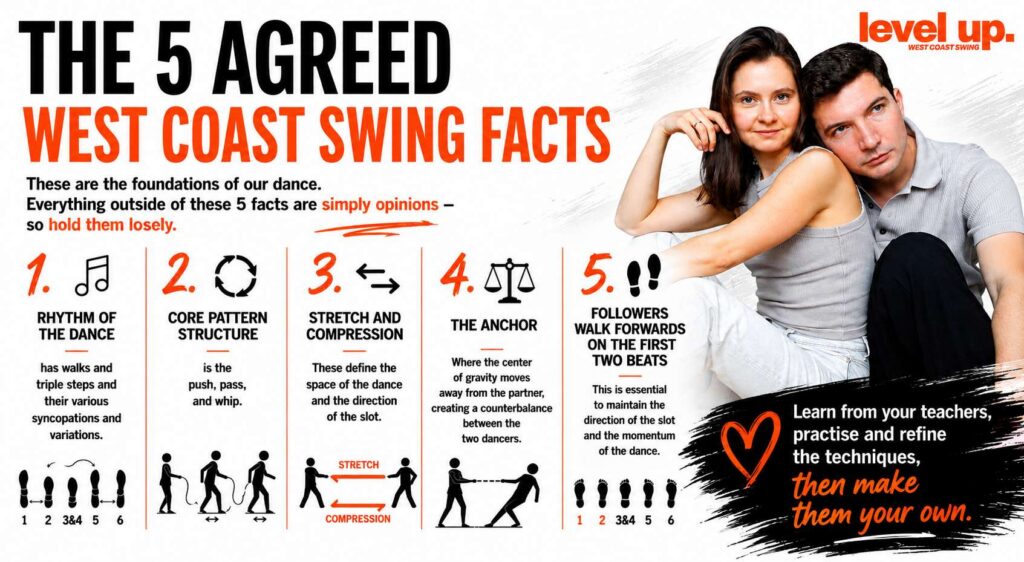
These aren’t rules designed to restrict creativity.
They’re the foundations that allow all that creativity to happen while the dance remains recognisably West Coast Swing.
There Is No Finish Line
One of the wonderful things about West Coast Swing is that you never really finish learning it.
And that’s true at every level.
Your first breakthrough might simply be getting through a Sugar Push without thinking about every step.
Later, you might discover what connection actually feels like.
Then you start hearing phrases in the music you never noticed before.
You become more comfortable improvising.
Your movement improves.
Your partners start giving you ideas.
Something a teacher told you three years ago suddenly makes sense because you’re finally ready to understand it.
Progress isn’t always linear either.
There will be periods where you feel like you’re improving rapidly and others where you wonder whether you’re improving at all.
That’s part of learning something with this much depth.
West Coast Swing gives you enough structure to start dancing relatively quickly and enough freedom that you can continue exploring it for the rest of your life.
You don’t need to become the best dancer in the room.
You don’t need to chase somebody else’s journey.
You just keep learning.
Keep dancing.
Keep discovering what’s possible.
And hopefully, keep enjoying the journey of becoming a better dancer.
Never Stop Growing.