
The 5 Agreed Facts of West Coast Swing (And Why Everything Else Is Just an Opinion)
If you’ve been dancing West Coast Swing for any length of time, you’ve probably experienced this:
- One teacher tells you to relax.
- Another tells you to stand taller.
- One says your feet spacing should be bigger.
- Another says it should be smaller.
- One wants more stretch.
- Another says you’re creating too much stretch.
- One encourages styling.
- Another tells you to strip everything back and focus on basics.
At some point, many dancers start wondering:
“Who’s right?”
The longer I’ve danced, the more I’ve realised that this confusion is actually a normal part of learning West Coast Swing.
Unlike some dances that have a rigid syllabus and strict technical requirements, West Coast Swing has evolved through decades of social dancing, competition, music changes, and personal expression.
As a result, you’ll often hear highly successful dancers teach things differently.
Sometimes very differently.
And yet those same dancers can all step onto the floor and create incredible dances.
So how can that be?
The answer is surprisingly simple.
While there are countless opinions about technique, styling, movement, connection, posture, musicality, and aesthetics, there are only a handful of things that virtually every Champion-level dancer agrees are fundamental to the dance.
- Everything else exists somewhere on a spectrum.
- Everything else can be explored.
- Everything else can be adapted.
- Everything else can become part of your personal expression.
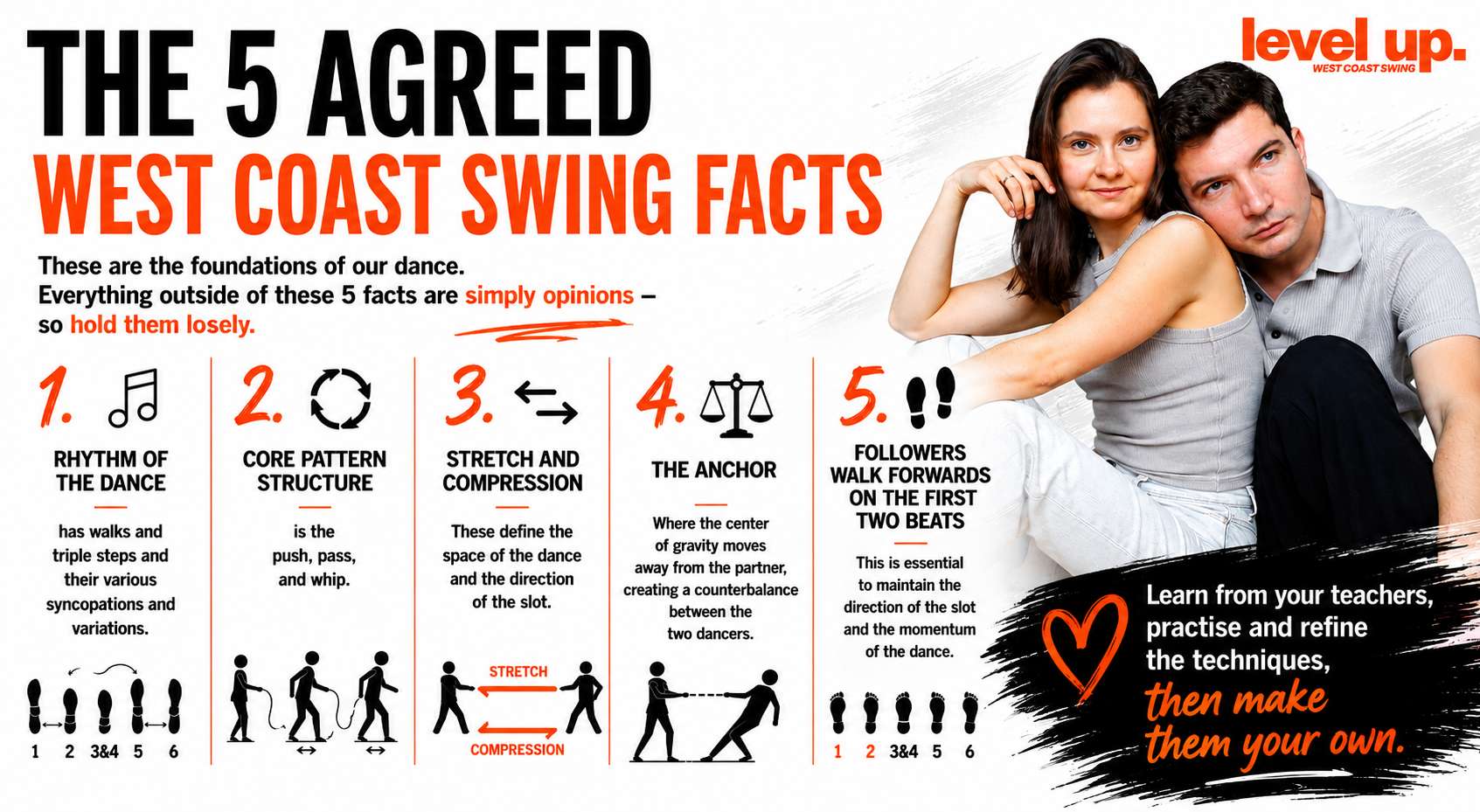
The five agreed facts are:
- Rhythm of the Dance
- Core Pattern Structure
- Stretch and Compression
- The Anchor
- Followers Walk Forward on the First Two Beats
Let’s explore each one.
1. Rhythm of the Dance
At its heart, West Coast Swing is built on walks and triple steps.
Whether you’re dancing beginner basics, Champions division finals, or a social dance at 2am, the underlying rhythm of the dance comes from these building blocks and their many variations.
- Walks.
- Triple steps.
- Syncopations.
- Rhythmic substitutions.
- Extensions.
- Delays.
- Accelerations.
The dance can look wildly different from one couple to another, but underneath it all these rhythms provide the foundation.
You might choose different footwork. You might syncopate. You might interpret the music creatively.
But the rhythm remains one of the core pieces of the dance.
Without it, we stop speaking the language of West Coast Swing.
2. Core Pattern Structure
West Coast Swing is built around three fundamental pattern families:
- Pushes
- Passes
- Whips
Everything else grows from these concepts.
- Sugar pushes.
- Left side passes.
- Underarm passes.
- Whips.
- Whip variations.
- Modern patterns.
- Creative extensions.
At their core, they all derive from these foundational structures.
Think of them like grammar in a language.
You can write poetry. You can tell jokes. You can invent new expressions. But the grammar still provides the framework that allows communication to happen.
When dancers understand these pattern families, they gain the ability to recognise and understand almost everything else that appears in the dance.
3. Stretch and Compression
Stretch and compression define the space of the dance.
- They create direction.
- They create elasticity.
- They create conversation.
Compression occurs when energy is directed toward the shared connection.
Stretch occurs when energy is directed away from the shared connection.
Together, they form one of the defining characteristics of West Coast Swing.
Different dancers may create different amounts of stretch.
Different teachers may prefer different aesthetics.
Some may favour a more elastic approach.
Others may favour a more grounded approach.
But everyone agrees that these opposing connection states are fundamental to how the dance functions.
Without them, the slot loses clarity. Momentum becomes harder to manage. Communication becomes less efficient.
Stretch and compression aren’t simply techniques. They’re part of the language that allows two people to have a physical conversation.
Ready To Level Up Your West Coast Swing?
If you’re passionate about improving your dancing, but don’t always have access to Champions, private lessons, or regular workshops, you’re not alone.
That’s exactly why I created the Level Up Online Community.
✅ Training resources from Champion and All-Star dancers
✅ Monthly learning themes to help you focus on what matters most
✅ Technique breakdowns and practice ideas
✅ A supportive community of dancers from around the world
✅ Opportunities to ask questions, share videos, and get feedback
4. The Anchor
The anchor step is one of the most discussed concepts in West Coast Swing.
It’s also one of the most misunderstood.
Many dancers think of the anchor as simply “the last triple.”
But the anchor is much more than footwork.
The anchor is the moment where the dancers’ centres move away from one another, creating a counterbalance relationship.
This counterbalance creates the end of one pattern and prepares the beginning of the next.
- It establishes clarity.
- It creates opportunity.
- It provides choice.
Without an anchor, dances often feel rushed.
Leads begin before followers have completed. Followers feel pulled out of patterns prematurely. Musical opportunities disappear.
The anchor creates space. And in dance, space is often where the magic happens.
5. Followers Walk Forward on the First Two Beats
This one sounds incredibly simple.
Yet it’s one of the most important concepts in the entire dance.
Followers moving forward on counts one and two maintain the direction of the slot and preserve momentum.
This forward movement allows the dance to flow.
- It creates efficiency.
- It creates predictability within the partnership.
- It allows leaders and followers to communicate more effectively.
The rule exists first. The exception becomes meaningful later.
So What About Everything Else?
This is where things get interesting.
Because once we move beyond these foundational concepts, we enter the world of interpretation.
And interpretation is where art lives.
Should your anchor be bigger or smaller? Opinion.
Should your posture be more upright or more relaxed? Opinion.
Should your movement be more grounded or more floating? Opinion.
Should your styling be minimal or expressive? Opinion.
Should your triples travel or stay compact? Opinion.
That doesn’t mean these ideas are wrong. Far from it. Many of them are incredibly useful. Many come from brilliant teachers with decades of experience. Many can transform your dancing.
But they are still interpretations of the dance rather than universally agreed requirements. And that’s an important distinction.
The Danger of Chasing Certainty
One of the biggest traps dancers fall into is searching for the “one correct way.”
I’ve certainly done it myself.
You hear a Champion explain something and think: “Finally. This is the answer.”
Then six months later another Champion explains the same concept differently.
Now you’re confused again 🤬.
The reality is that many top dancers are solving the same problem using slightly different methods.
- Their bodies are different.
- Their experiences are different.
- Their artistic preferences are different.
The goal isn’t to find the single perfect opinion.
The goal is to collect useful ideas and discover which ones help you create the dance you want to create.
Learn the Rules. Then Make Them Your Own.
The best dancers I’ve met all seem to have something in common.
- They respect the foundations.
- They understand the mechanics.
- They appreciate the history.
But they don’t become trapped by imitation.
They learn. They experiment. They adapt. They develop their own voice.
If every dancer applied every piece of advice exactly the same way, every social floor would look identical.
Every competition final would look identical. Every dance would feel identical. And West Coast Swing would lose much of what makes it special.
The beauty of the dance comes from individuality.
The fundamentals provide the framework.
The artist provides the expression.
Final Thoughts
The next time you hear two teachers give seemingly contradictory advice, don’t panic.
Ask yourself:
Is this one of the foundational principles of the dance?
Or is it an interpretation?
If it’s one of the five agreed facts, pay close attention.
Those foundations appear again and again across every level of the dance.
If it’s an interpretation, stay curious. Experiment with it. Try it. Keep what works. Discard what doesn’t. Refine your understanding over time.
Because West Coast Swing isn’t about becoming a soldier who perfectly follows orders.
It’s about becoming an artist who understands the language deeply enough to express something uniquely their own.
Learn from your teachers. Practise and refine the techniques. Then make them your own ❤️
Over To You
One of the things I love about West Coast Swing is that no two dancers see the dance exactly the same way.
- Different teachers emphasise different ideas.
- Different Champions prioritise different techniques.
- Different communities develop different preferences.
And yet we’re all dancing the same dance.
I’d love to hear from you:
What’s the most contradictory piece of West Coast Swing advice you’ve ever received?
Was it about anchors? Stretch? Posture? Timing? Styling?
Drop a comment below and share your experience. You might be surprised to discover that other dancers have been wrestling with exactly the same questions.
As a follower, being told I’m too strong I am too strong in the arms and then the very next man telling me I’m too weak in the arms. 🤷♀️
Oh, I’ve been there too 🙂
Some people don’t like my connection, and some tell me they love it 🫠